

- News
- Kyoto Deep Tech.
"Teammates" who transcend self-interest become the founding team
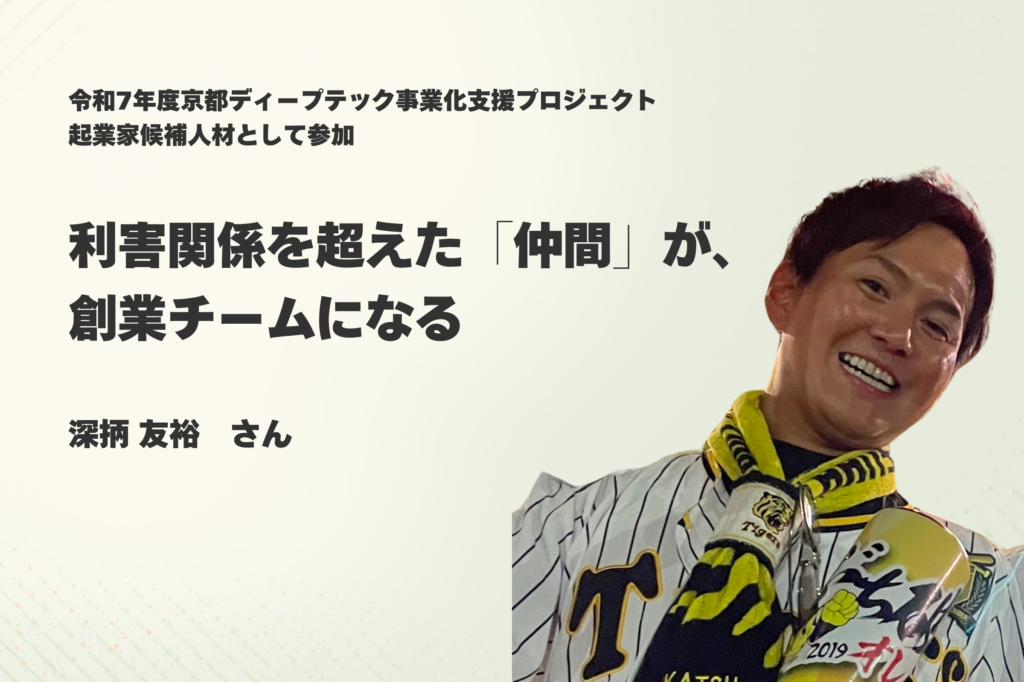
Kyoto Deep Tech Commercialization Support ProjectHere, university researchers and aspiring entrepreneurs come together to tackle business development through lectures, discussions, and hands-on experience. For Tomohiro Fukasawa, who participated last year, the greatest takeaway was not just a business idea. They weren’t coworkers, friends, or business partners. Yet, driven by a shared desire to “solve social issues,” they naturally came together and met fellow members who were moving toward a common goal. Before the project began, none of them had ever met. Yet, just a few months later, they were tackling a business venture together as new “comrades”—neither coworkers nor friends. How did this founding team come to be?
Make Your Sense of Purpose the Starting Point for Your Business
For this project, you don’t need to have a fully formed business idea from the start. What’s required is to ask yourself, “What social issue do I want to solve?” Through his involvement with his family’s torii gate manufacturing business in Kyoto, Mr. Fukasawa had long wondered if there was a way to put the cedar and cypress sawdust generated during production to better use. While large quantities of this material are produced, disposing of it is costly. He researched various potential uses—such as fuel and pet products—but never found a solution that felt like “the one.”
The program begins with a dialogue between participants and a Ribanes communicator. “What social issues do you want to solve?” “What kind of future do you want to realize?” The communicator carefully draws out the participants’ own thoughts and experiences, then seeks out researchers whose work resonates with them. While Ms. Fukasawa was expressing her desire to “do something with wood,” she was introduced to Professor Matsuura with the suggestion, “If that’s the challenge, this researcher might be a good fit.” A defining feature of this project is that it connects participants with researchers based on their personal aspirations, rather than by searching for research leads.
An Encounter with Research Transformed the Value of Local Resources
Drawing on his many years of research on insects, Professor Matsuura is conducting research to use termites to break down unused wood and convert it into animal feed and food. “Termites eat the sawdust produced during the manufacture of torii gates, and chickens eat those termites.” The moment that image came to mind, the challenges regarding local resources that Mr. Fukasawa had long grappled with and the university’s research technology came together as a single, clear connection. This gave rise to a business concept called “Kyotori-i,” in which termites raised on sawdust are used as feed, and the chickens that eat those termites are marketed as a Kyoto brand.
This project isn’t just about listening to researchers present their technologies and then calling it a day. We align the challenges participants face with promising research opportunities, and together we seek common ground—moments where participants think, “With this technology, I might be able to make progress on the problem I want to solve.” From these conversations, the seeds of new business ventures are sown.
Through the lectures, a “founding team” begins to take shape
Over the next six months or so, participants learn how to analyze social issues, formulate business hypotheses, and identify the value of technology, while repeatedly presenting their ideas and engaging in extensive discussions with one another. “Whose problems are we solving, and what kind of problems are they?” “What should we test?” Researchers, aspiring entrepreneurs, and communicators held numerous brainstorming sessions to continuously refine their hypotheses. Over time, it gradually became clear with whom they wanted to take on this challenge.
In addition to Professor Matsuura, who led the research, people naturally began to gather around Mr. Fukasawa—including Mr. Matsuyama and Mr. Fujiwara, who also participated as aspiring entrepreneurs; Mr. Ishijima, a Kyoto City government employee; and Mr. Takahashi, a student at Kobe University. The members come from diverse backgrounds—the private sector, government, academia, and students—with varying roles and areas of expertise. Moreover, before the Kyoto Deep Tech Commercialization Support Project began, none of them knew each other at all. Nevertheless, through discussions during each lecture, refining ideas, visiting researchers, and talking about the market, their respective roles gradually took shape.
Professor Matsuura led research and development, while Mr. Shen Gao mapped out the overall business strategy. Mr. Ishijima established connections with government agencies, Mr. Matsuyama and Mr. Fujiwara supported business development, and Mr. Takahashi joined the team to provide insights from the research front lines. For Ms. Shen, this was the first team she had ever been part of that was brought together solely by a genuine desire to solve social issues—a group quite different from a baseball team or a group of coworkers. Even after the program ended, these members naturally stayed in touch, continuing to discuss company formation, research grant applications, and preparations for pilot tests. Their relationship evolved beyond a temporary project partnership into a founding team working toward a shared vision for the future.
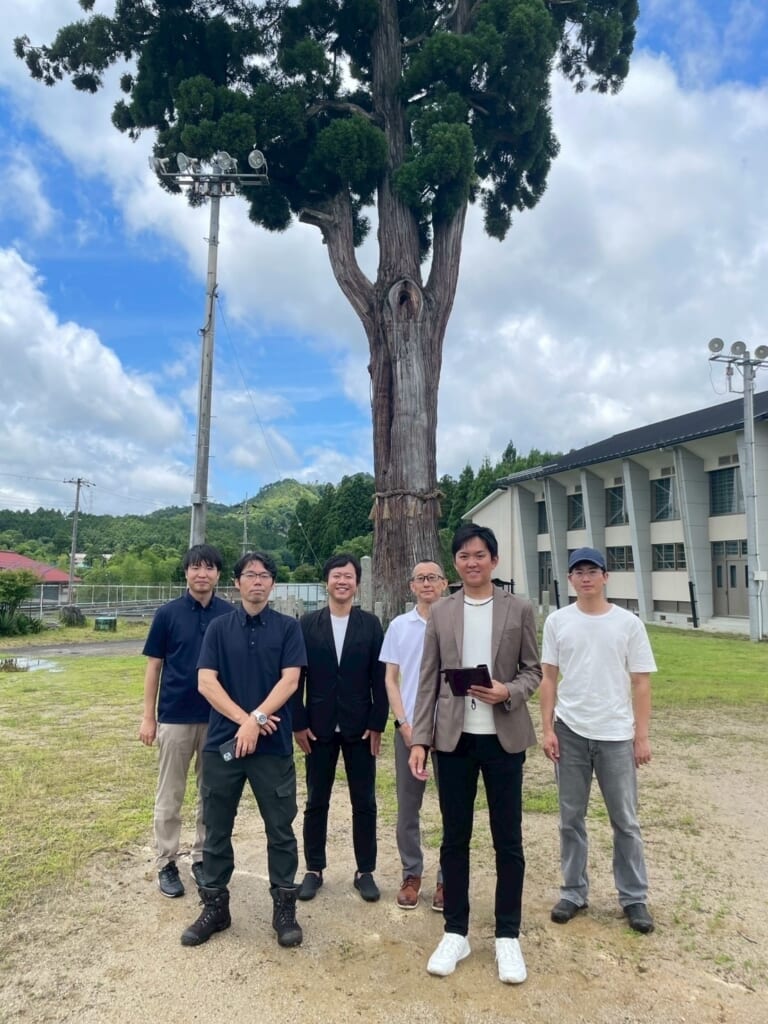
A startup team formed through the Kyoto Deep Tech Commercialization Support Project
Neither just a researcher nor just an entrepreneur
To bring research findings to society, it’s not enough to rely solely on researchers or entrepreneurs. We need people who understand the technology, people who identify social issues, people with connections to local communities, and people who can turn the research into a viable business. Only when each of these individuals contributes their unique role does the process of social implementation truly begin. Mr. Fukasawa himself was not a termite expert. He joined the project driven by a desire to find a solution for wood damage, and through lectures, discussions with researchers, and market research, he gradually shaped his business concept. The greatest asset he gained through this process was neither the technology nor the business plan. “It was the formation of a team where industry, government, academia, and the public sector came together with a genuine commitment to solving social issues. A community like this has never existed before.” As his words suggest, the Kyoto Deep Tech Commercialization Support Project is not merely a platform for matching researchers with aspiring entrepreneurs. It is a space where people who are serious about solving social issues come together to form startup teams that transcend individual interests. “If you just want to start a business, you could open a ramen shop. But there are still very few entrepreneurs who apply research to real-world solutions,” says Mr. Fukasawa. Connect university-developed technologies with social challenges and meet like-minded people who will create new value. As a starting point for this challenge, the Kyoto Deep Tech Commercialization Support Project awaits those ready to take that first step.
<プロフィール>
Mr. Tomohiro Fukasawa
Born in January 1986 in Kyoto City, Kyoto Prefecture. After graduating from Konan University, he worked in retail sales at a major non-life insurance company, spending three years in a regional city and seven years in a major metropolitan area. In fiscal year 2017, he was awarded the MVP Award in recognition of his management and sales skills. After leaving that company, while working in the restaurant industry and management consulting, he realized his lack of knowledge and enrolled in a business school. In 2022, he earned a Master of Business Administration (MBA) from the Graduate School of Hyogo Prefectural University. He is currently a full-time employee at a BPO and business consulting firm, where he primarily focuses on team operations and member management. He is currently preparing to launch a deep-tech venture spun out of Kyoto University, utilizing his time on weekends and weekday evenings.
 English
 Japanese