

- Interview with Adventure Talent
- News
Pursuing our passion for robotics to the fullest and delivering products that support people
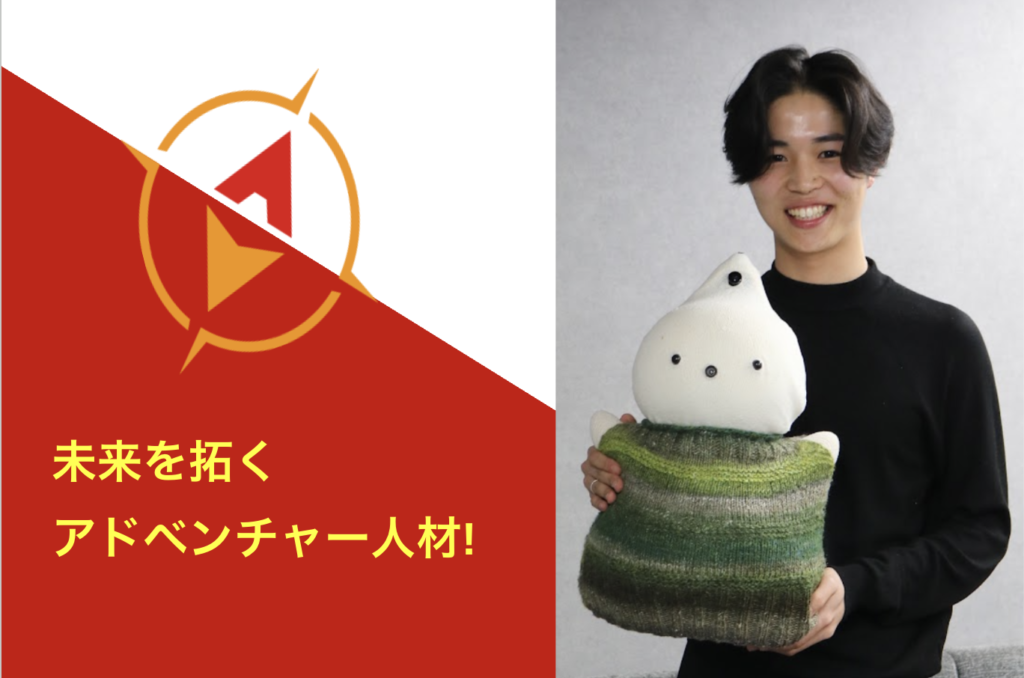
This article is a re-edited version for online publication, based on an interview originally published in Volume 28 of the “Human Resources Support” booklet, titled “The Turning Point of 2025,” which was released in June 2025.
Speaker
Keio University
School of Environmental Information, Department of Environmental Information, 1st Year
Nijito Shinobe
With a mission to “alleviate the loneliness of hospitalized patients and children,” the team is engaged in the research, development, and field testing of communication robots in medical settings. Notable creations include the hugging robot “Hug Bot” and the warmth-transmitting robot “Breath.” In 2023, the team won the Edge Award and the Ubloom Award at the “Reiwa 5 Kanagawa Student Business Idea Contest,” and in 2024, they exhibited at the “Culture Festival for Thinking About the Future of Disabilities,” organized by SFC-IFC. Subsequently, he participated as an invited student in the Livanes Scholarship Taiyo Yuden Seminar and was selected to give an oral presentation at Science Castle Japan 2025, held in March 2025. He is currently working as a researcher at the Next-Generation Research Institute’s Advance Lab.
Interviewer
Leave a Nest
Executive Officer and CBO, and Representative Director of ADvance Lab, Inc.
Naoko Matsubara
He earned a Master of Agriculture from the Division of Biological Production Sciences, Graduate School of Agricultural Sciences, Tokyo University of Agriculture and Technology. Having gained experience in a wide range of business fields—from research and development to business management, regional development, and educational development—he was appointed Executive Officer in 2012. He is responsible for launching and strategically managing new businesses for major corporations and key regional companies, while also providing support for research and development and business development at venture companies. Additionally, within the Corporate Planning Office, he is responsible for planning and developing the company’s branding and human resource development initiatives, working to strengthen the organization’s foundation and enhance its value.

Kohito Shinobe built numerous robots during his high school years. Inspired by challenges faced by his friends and their families, he has continued to develop robots designed to support people, while listening to firsthand accounts from various settings, including local nursing homes and the National Center for Child Health and Development. Through Shinobe’s journey—in which he has expanded the scope of his activities starting from robot development—and his vision for the future, we take a glimpse into the world to come.
I Want to Eliminate “Loneliness” Through the Power of Robots
Matsubara:Thank you for bringing so many robots. I heard you built these while you were in high school. What first got you so interested in building robots?
Shinobe:I first tried building a robot as part of an independent research project in my second year of middle school. It all started because “I enjoyed making things,” but I’m not the type to stick with something just for the sake of making it. I couldn’t pour my heart into it unless I could imagine how the robots I built might be useful to people. What really got me hooked was something a classmate’s mother said when I was a sophomore in high school. She was hospitalized with terminal cancer, and when I heard her wish—as a mother—to participate in events like parent-teacher conferences even from her hospital room, I wondered if I could use my own engineering skills to make her wish come true. That’s how I developed “Robo-Kuma.” I spent my summer vacation building it—a robot equipped with a camera, microphone, speaker, and servo motor inside—that could be remotely controlled from a hospital room to enable real-time conversation, as long as someone carried it to the desired location.
Matsubara:So, this is a robot that allows children to feel close to their friends’ mothers—and, in turn, allows those mothers to feel close to the children. On the other hand, even if it was sparked by something a friend’s mother said, I imagine there was a shift in your own feelings, Mr. Shinobe, that led you to want to develop a robot. Looking back on it now, what are your thoughts?
Shinobe:“Wanting to alleviate loneliness” is the goal shared by all robots, but from that perspective, my formative experience might have been living apart from my father for four or five years during elementary school. My mother worked as well, and I remember spending a lot of time alone during my early elementary school years. Looking back now, I think it was that sense of loneliness I felt back then that caused my body to react—or rather, made me unable to just let it go—whenever I heard my friends talk about their families.
Matsubara:That formative experience must have been what sparked your passion, leading you to immerse yourself in robot development. It really does take a powerful formative experience, doesn't it?
An Interface Designed for Just One Person
Matsubara:As I listen to you, I sense a desire to foster communication among people who face some kind of limitation—such as those who are separated from loved ones or unable to go where they want to go. What led you to choose robots as the means to achieve this?
Shinobe:That's right. Actually, I don't intend to fixate on robots. But I think it's best to view this as a phase where we're delving deeper into the hypothesis that robots might be a good way to connect people who are physically apart.
Matsubara:I felt that the idea of not getting too attached to specific methods was very fundamental. When supporting entrepreneurs, there are moments when, as they become absorbed in what they want to do, they gradually start focusing solely on technology. Since I believe technology is ultimately just one of many tools, it’s important to return to your roots and original goals and reevaluate things. By the way, the robots Mr. Shinobe has created through his work each have distinct visual characteristics. Is there a particular reason for that?
Shinobe:Yes. These are the results of our efforts to respond to feedback from the field. For example, we initially created the “HugBot” hugging robot based on a friend’s younger brother’s wish to hug his mother. We designed its center of gravity so that it would fall over if not supported, and shaped it in a way that naturally makes people want to hug it. However, we received feedback that it failed to evoke the sensation of a hug or convey a sense of life. So, next, we focused on warmth and developed “Breath,” a robot with human-like breathing. Initially, it had a face like “HugBot,” but staff at a pediatric hospital pointed out that a face would remind children of people and might actually make them feel lonely. As a result, it is now designed to look human-like but not human. Consequently, we’ve seen cases where even children who normally raise their voices calm down when holding “Breath,” demonstrating a certain level of effectiveness. Although it’s not yet in its final form, I feel that we’re heading in the right direction.
Matsubara:That really is product development that listens closely to the voices of those on the front lines. I also feel reassured when I hold Breath (laughs). Mr. Shinobe, what kind of conviction drives you in robot development?
Shinobe:No matter what kind of product I’m creating, I don’t think I can build something that solves the problems of 100 people right from the start. Instead, I hope to create something that truly meets the needs of the one person right in front of me—and that, as a result, it will evolve and spread so that 10, then 100 people will start using it. But first and foremost, I make a conscious effort to keep focusing on the person right in front of me.
Matsubara:I understand that your range of knowledge and skills has expanded to meet your needs. I imagine you’ll be entering college soon to further develop your expertise, but is there a reason you chose Keio University’s School of Environment and Information Studies (hereinafter referred to as SFC) rather than an engineering school with many robotics experts?
Shinobe:At first, I was planning to attend a university with an engineering program. However, as I researched science and engineering departments and looked at their curricula, I realized I wouldn’t be able to learn everything I wanted to. I wanted to take an approach that went beyond simply developing technically advanced products from an engineering perspective—I also wanted to incorporate the psychological and physiological reactions of users into the product’s design. While searching for a university where I could study from the perspective of designing for emotional transformation, I came across SFC.
I want to increase the number of people who work together to develop and deliver science and technology for the benefit of others.
Matsubara:I’d like to ask you about your future plans after college. What are your thoughts on your path after graduation?
Shinobe:Right now, I’m thinking about starting my own business. Of course, I recognize that going to graduate school to gather solid evidence, write a good thesis, and present at academic conferences is one option. However, beyond research and development, I have a strong desire to see things through all the way to the phase where I can actually deliver my work to the people right in front of me. I’m genuinely interested in transforming the experiences of the people who receive the products I create, so while I plan to incorporate academic approaches and methodologies from research and development, my main focus is on social implementation. If anything, I see starting a business as a means to achieve that goal.
Matsubara:With 2022 being hailed as the “first year of startups” and the entrepreneurial movement gaining momentum across Japan, it’s easy for the ends and the means to get mixed up without us even realizing it. However, I sensed a strong determination in him: “I want to use entrepreneurship as a means to sustainably bring about the world I want to create.”
Shinobe:Perhaps the biggest factor was that the first Robo-Bear I developed never made it to the person I wanted to deliver it to. We had just finished development and were about to begin testing as part of the pilot phase, so I’d set a date with a friend’s mother—but she passed away just one day before I was supposed to deliver it. Immediately after that, driven by the frustration of not being able to deliver it to the person I intended to, I went through a period of soul-searching, questioning why I was even creating things in the first place. Looking back on that time, I realized that when there’s someone right in front of me who needs help, and when I feel needed by that person, that’s when I find joy in creating products. That’s why I think I’m so committed to real-world implementation.
Matsubara:That really makes sense. Starting this April, you joined ADvance Lab (hereinafter “AdLab”)—a research institute by the next generation, for the next generation—as part of its second cohort. I imagine you’ll be making more and more friends involved in product development at SFC as well, but what made you decide to join AdLab?
Shinobe:What drew me to AdLab was the thought that I would be inspired by my peers who were working hard. Last year, I was invited to participate as a guest student in the “Lifeness Scholarship: Taiyo Yuden Seminar,” a program run by Lifeness and Taiyo Yuden Co., Ltd. During that seminar, we spent four months where everyone presented monthly progress reports, set goals for the following month, and then carried out our activities. I realized that my research would accelerate if I embraced that atmosphere of healthy competition, which is why I was drawn to AdLab, where I could experience that year-round.

Matsubara:So, you decided to join AdLab to bring together peers from your generation. How have you approached product development up until now?
Shinobe:Up until now, I’ve been doing this mostly on my own. While I’ve received advice from various adults, I’d really like to find some peers who can work with me on the technical aspects. For example, since my knowledge of mechanical design and electronics is still limited, I’m planning to look for peers at AdLab and at the university.
Matsubara:Since founding AdLabo, I’ve had far more opportunities to interact with the next generation of researchers. Like Mr. Shinobe, I’ve come to realize that their ways of thinking, codes of conduct, and scope of activity differ significantly from what came before, and that the values I once took for granted are changing. As we move forward with development, I imagine there will be more opportunities for collaboration with companies. From your perspective, Mr. Shinobe, what do you expect from companies today?
Shinobe:I believe it’s important to use science and technology with a clear understanding of whose problems we’re solving and how. While Japanese companies possess overwhelmingly advanced technology, I get the impression that the focus has become too much on simply creating that technology, and there’s a bit of a lack of perspective on how to integrate it into society. So, I hope more companies will start operating with a focus on how to use that technology to benefit society and people, and I aspire to become someone who can design solutions in that area.
Build empathy through dialogue, rather than imposing your beliefs
Matsubara:I'm really interested in how Mr. Shinobe's values—the ones he talked about today—came to be.
Shinobe:My long-held conviction is that “science and technology should be used for the benefit of society and humanity.” Robots, depending on the circumstances, can sometimes be seen as taking away people’s jobs, and the pursuit of robots that resemble humans can sometimes draw criticism from an ethical standpoint. Amid all these differing opinions, I always remind myself to consider whose problems we are solving and whether our efforts are truly benefiting society and humanity.
Matsubara:Perhaps it was because you resonated with Ribane’s vision of “advancing science and technology and contributing to the planet,” but over the past two years, you’ve participated in so many of Ribane’s initiatives, haven’t you? Did you ever feel any hesitation about meeting people you didn’t know at all, even though you were stepping outside the confines of your high school?
Shinobe:I don’t really feel like there’s any particular hurdle. I actually really enjoy spending time with people I’m meeting for the first time, looking for common ground and sharing what we each do. It’s not about dragging them into my own world, but realizing that while we have different values and approaches, the world we’re aiming for is actually quite similar. I find it fun to take the time to think about things like that.
Matsubara:I feel that this is exactly the same as the concept of “bridge communication” that Ribane values. We practice a style of communication where we first understand what the other person is thinking right now, what they want to do, what their background is, and what kind of direction they’re heading in—and then align that with our own direction. I’m surprised that they’ve already acquired this way of thinking by the time they’re in high school.
Shinobe:I think my mother’s influence was definitely a big factor. Whenever I did something wrong, instead of getting angry, she always made a point of having a conversation with me. Even when we argued, she wouldn’t let me walk away until we’d worked things out. There were times when we talked nonstop for as long as two days. I think that experience gave me the sense that I can understand anyone, no matter who they are.
Matsubara:That’s a very meaningful experience. I felt that the very process of Mr. Shinobe’s personal development holds clues to the mindset needed to adapt to the changing world. Thank you very much for today. Let’s have fun taking on new challenges together at AdLab from now on.
(Written by Kohei Kaura)
 English
 Japanese