

- Interview with Adventure Talent
- News
"One's true self" emerges from interactions with others.
This article is a re-edited version for online publication, based on an interview originally featured in Vol. 29 of the “Human Resources Support” booklet, “The Turning Point of 2025,” published in September 2025.
Speaker
Mr. Masaki Takeuchi
Colloquium, Inc. Representative Director
Completed the Ph.D. program in Electrical Engineering at the Graduate School of Engineering, The University of Tokyo, and earned a Ph.D. in Engineering. While enrolled in the master’s program in the same department, he served as the leader of the development team for “Laryphonix,” a hands-free, electrically powered artificial larynx, as part of a student project. He founded Colloquium, Inc. in April 2025 and currently holds his current position. His goal is to create a world where people who have lost their voices can speak without difficulty in their daily lives.
Interviewer
Yuko Ueno
General Manager, Group Development Division, Ribanes Co., Ltd.
Mr. Masaki Takeuchi
Colloquium, Inc. Representative Director
Ph.D. (Science). While in school, he explored the origins of life through his study abroad experience in the United States. He joined Livanes Co., Ltd. in 2013. In the Human Resources Development Division, he developed training programs in the U.S. for young Japanese researchers. After serving as the division’s general manager for two years, he became editor-in-chief of the magazine “Startup Support,” where he engaged in dialogue with numerous venture company executives. After gaining experience supporting Japanese deep-tech startups in expanding into Southeast Asia and helping Southeast Asian startups enter the Japanese market, he was appointed General Manager of the Group Development Division in October 2021. To maximize the potential of the Ribance Group, he aims to establish a knowledge platform that integrates Southeast Asia and Japan.
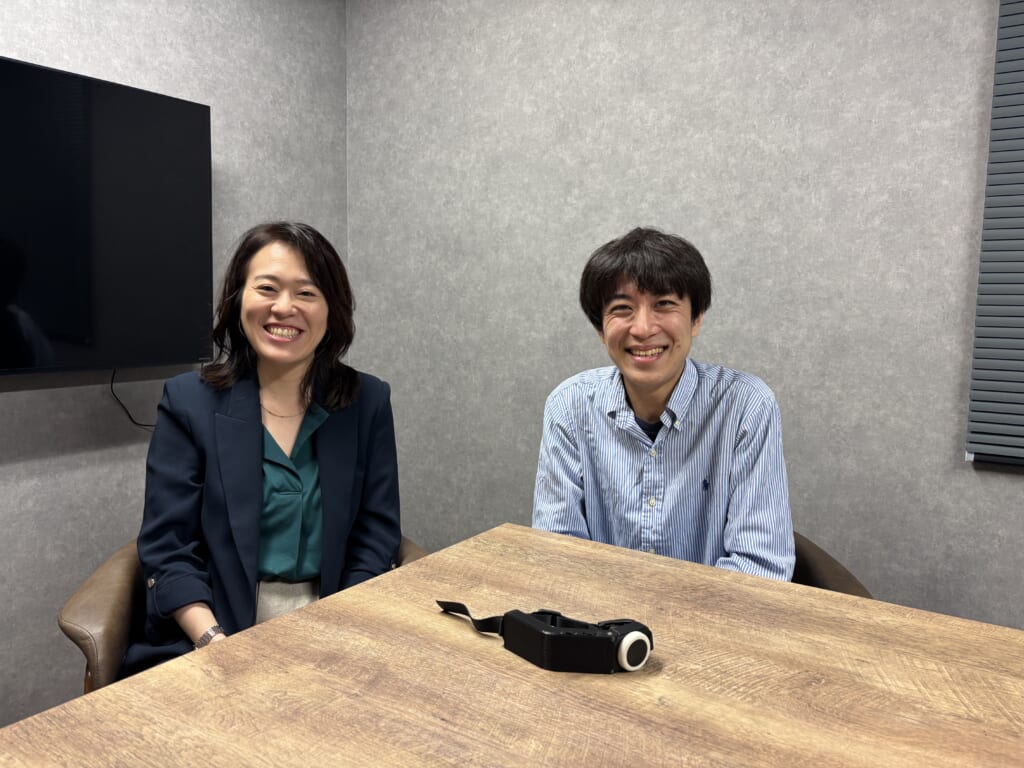
Masaki Takeuchi is working on the development of “Reariphonics,” a device for people who have lost their voices. He started his business driven more by curiosity and a desire to help people in need than by income or stability. While conventional speech-assist devices typically involve placing a unit against the neck to produce sound through vibration, the electric larynx Mr. Takeuchi is developing is worn around the neck with a strap. He explains that his research into how to support the “voices” of people who have difficulty speaking aims to realize a world where those who have lost their voices can regain them and communicate freely. Through a dialogue between Mr. Takeuchi and Yuko Ueno of Lifeness Inc., the fundamental question of “what it means to be human” and the importance of human relationships came to the fore.
Interacting with People with Disabilities
Issues I've Identified
Ueno: I hear that the "RealiPhonics" electronic artificial larynx being developed by Mr. Takeuchi allows users to speak simply by wearing it around their neck and moving their lips.
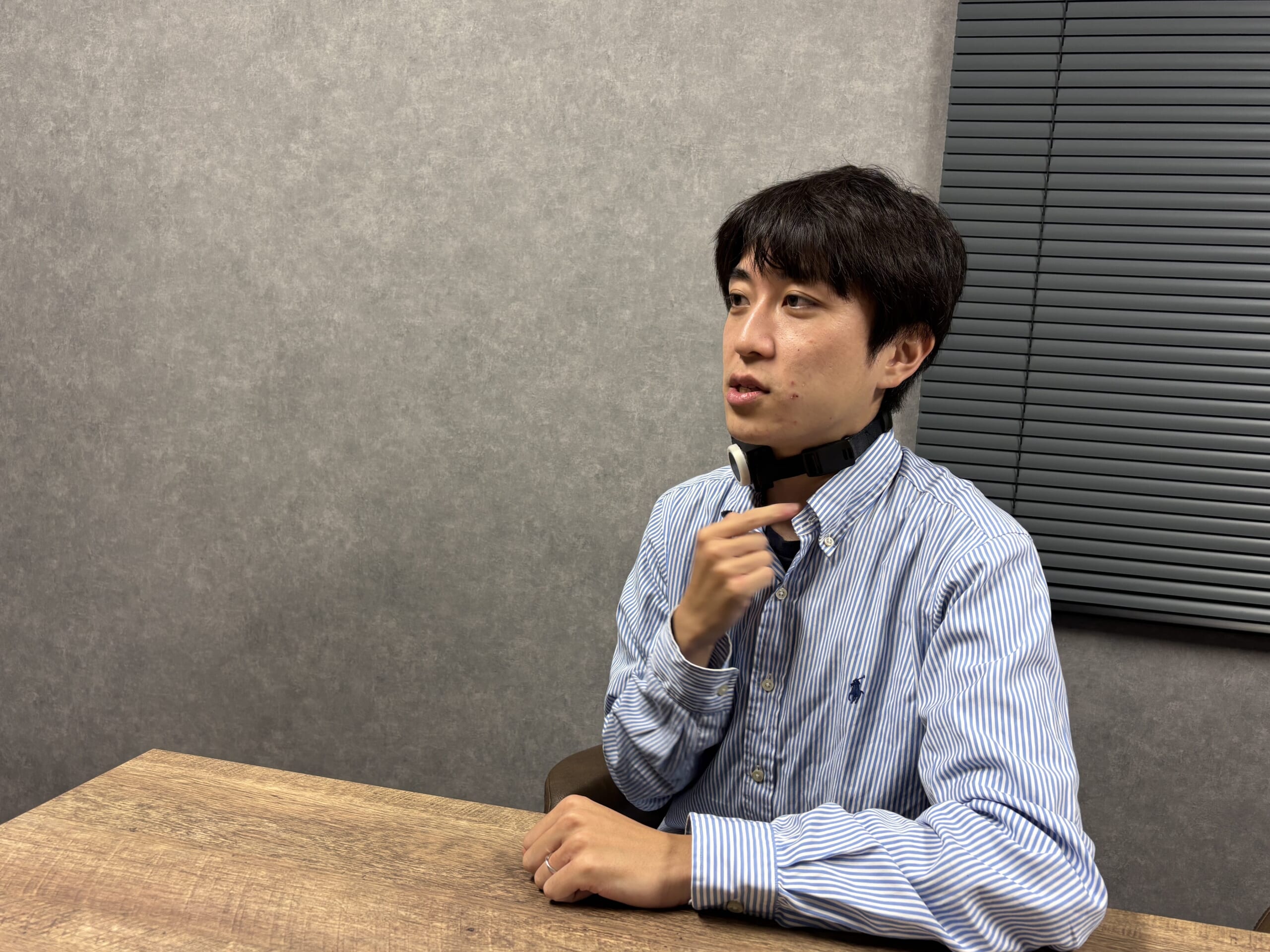
Takeuchi:Yes, it generates vibrations based on a pre-recorded sample of the person’s voice, and those vibrations are transmitted to the throat via a vibrator located at the base of the neck. From there, the person produces sound by changing the shape of their mouth and tongue.
Ueno:It looks stylish, too. Could you tell us about the development process?
Takeuchi:It all started when I was in high school and a member of the basketball team. I visited a facility that teaches basketball to people with intellectual disabilities. That was my first time interacting with people with disabilities, and I was particularly struck by the sight of them dancing.
Ueno:What was it that made such an impression on you?
Takeuchi:You can’t tell just by looking at someone that they are deaf. But because they couldn’t hear the music, they couldn’t dance very well. I loved music, so I’d taken it for granted that I could hear sounds—but that wasn’t the case for everyone. It was a shock to realize that there are people who can’t do the everyday things I take for granted. That’s when I started thinking it would be wonderful if people who had lost their hearing could listen to music and enjoy it. After entering college, I took a seminar-style course on sound, where I also reflected on the relationship between people with disabilities and sound.
Ueno:What was the class like?
Takeuchi:The speaker was a professor in the Faculty of Letters who studies language. There is a rare, incurable disease called ALS (amyotrophic lateral sclerosis) that causes paralysis. The workshop focused on a technique in which an occupational therapist recorded a person’s voice before their symptoms worsened and they lost the ability to speak, and then reproduced that voice on a computer. While participating in the workshop, I realized for the first time just how agonizing it is for people with ALS to be unable to communicate with others. It was then that I came to understand that it’s not just about hearing sounds—making sounds is just as important.
Ueno:It’s true that when it comes to communication, it’s not just about hearing—the voice you use to convey your message is important, too.
Takeuchi:That's right. After that, through an introduction from a professor in the Department of Literature, I was able to participate in research with the Language Development Team at RIKEN for one year. The research focused on how babies learn language by analyzing the words mothers speak to them. This is where I became involved in speech research as well.
Ueno:So, what made you decide to build this device?
Takeuchi:I was conducting research in computer science as an undergraduate, but I began to feel that I wanted to focus more on speech research. So, for graduate school, I transferred to a different university and joined a lab focused on social welfare rather than speech.
Ueno:Changing both universities and fields of study is a challenge. It seems my interest in vocal techniques had been growing.
Takeuchi: While conducting my research, I came across a YouTube video of someone who had undergone a laryngectomy practicing with an external artificial larynx. It involved placing a small handheld device against the throat or under the chin to transmit vibrations into the mouth, thereby producing sound. However, this method of speech made the voice sound robotic. In an era where technology exists to create natural-sounding voices—like Hatsune Miku’s—I found it jarring that the result sounded robotic. So, I wondered if I could propose a solution that would allow that person to speak in a voice that truly sounded like their own.
Ueno: How did you determine the direction of development?
Takeuchi:First, wanting to connect with people who had lost their voices due to laryngectomy, I contacted several social welfare organizations. They invited me to visit the Tokyo Welfare Center for Persons with Disabilities. When I went there, I found they were working on how to recreate a “voice that reflects the person’s individuality.”
Ueno:So, what they were really looking for was a voice that was “truly unique to that person.”
Takeuchi: Yes, when I spoke with those people, I was touched by their kindness and the way they treated me with genuine care. When I presented a prototype, they were eager to try it out. They also told me about the challenges they face in their daily lives. Among these, I learned that some people feel self-conscious about having their artificial larynx visible on their neck every time they speak, which makes them reluctant to talk to others. I’ve come to believe that the true significance of this development effort lies in helping these kind-hearted people I’ve met to speak and live their daily lives without any difficulties.
Ueno: So there were other factors besides voice quality that made people hesitate to speak or engage in conversation.
A Regained Voice Fosters Connections with Others
Ueno: Even though you’ve met the people directly affected, why are you so determined to go ahead with the development?
Takeuchi: While I do want to be of service to others, I also want to take on challenges that are true to myself and do things that only I am doing. I plan to pursue my own desires and leave a legacy for future generations.
Ueno: Since I’m also conducting research because I want to understand the origin of life, I understand that it’s driven by personal desire and curiosity.
Takeuchi: To be honest, I’ve been avoiding thinking about what’s best for myself. I’m not very athletic, and I lack confidence. I’m not good at thinking about my future. I’m not good at making plans for the future, and I have a strong desire to just focus on whatever is right in front of me right now.
Ueno: So you started a business even though you’re not good at thinking about the future. It seems like you’ve chosen a thorny path—one where you have to come up with your own questions and tackle challenges with no clear answers. Why are you taking on such a difficult challenge?
Takeuchi: When I was in college, right around the time everyone was job hunting, I was shocked to see a news report about a recent graduate who had joined a major corporation committing suicide. I realized that just because you join a major corporation doesn’t mean you’ll be able to do what you want, and that living that kind of life isn’t necessarily a good thing. I also realized that there’s no guarantee that company will remain stable forever. If that’s the case, it’s much better to do what I want to do. I thought that as I got older—10 or 20 years down the road—I’d probably look back and realize that was the better choice.
Ueno: While working for a large company would have provided a steady paycheck, I chose this path because I wanted to do what I’m passionate about and develop things that would benefit others and society—rather than simply valuing stability or money.
Takeuchi: Yes, it’s not so much that I want to become rich as it is that I want to help people. There are plenty of rich people out there, but take Steve Jobs, for example—he’s remembered precisely because he did things that no one else did. Of course, I’d be happy if I could make money. But I just thought that by doing something no one else has done, I could make a name for myself as an individual.
The pursuit of “humanity” is,
It's something people around me are asking for
Ueno:With previous technologies, while it was possible to produce speech using throat vibrations, the result sounded robotic, and the device attached to the neck was said to be quite conspicuous. Mr. Takeuchi, how do you incorporate “that person’s individuality” beyond just the voice?
Takeuchi: Actually, even if it’s not an exact reproduction of that person’s voice, there are people who say, for example, that Ken Takakura’s voice is great.
Ueno: So it's not just about reproducing the original voice exactly as it is, is it?
Takeuchi: It’s important to be able to speak in a way that doesn’t make the other person feel that something is off. Even if it’s not the person’s own voice, I believe it’s crucial that the voice they hear conveys that person’s “true character” 100%. We’ve also received feedback from users stating, “When a conversation isn’t flowing well, it can be hurtful when the other person pretends to understand just to be considerate of me.”
Ueno: It’s true—it’s sad when people are so self-conscious that they can’t communicate naturally.
Takeuchi: Yes. In communication, the speaker’s unique style of expression and how they typically behave in public are also important elements. If listening and speaking are the minimum elements necessary for conversation, I want to help students build upon their personal “desires”—such as wanting to sing with a more beautiful voice. Expression that stems from those desires is what connects to a person’s “humanity.”
Ueno: There’s also an expression that says you don’t go out of your way to put your thoughts into words.
Takeuchi: Not saying anything unnecessary is also part of his personality.
Ueno: The words we choose and how we want to be perceived—these are all part of who we are. Rariphonics embodies the meaning and value of a person’s way of life.
Takeuchi:The way you speak can change the sense of distance between the speaker and those around them. We hear this desire—not only from the users themselves but also from their families—that they want the user to speak “in a way that’s true to who they are.” That’s why family members have been accompanying us during our pilot tests. As development has progressed, we’ve reached a point where people now say, “I want to use this to make my grandchild happy.”
Ueno: It enables not only the person speaking but also those around them to communicate more actively.
Interactions with others
Toward an Era of Greater Value
Ueno: The voice encourages human interaction. Realiphonics isn't just a device for reproducing the voice; it's something that fosters human connection.
Takeuchi: Yes, without others, communication cannot take place. Even wealthy people can die alone, despite receiving care. Whether they’re elderly or have disabilities, people who are active in their communities are full of vitality. They work hard at something every day. That’s what makes them feel their life has meaning. Even people who hardly speak at home might strike up conversations with all sorts of people during community activities—say, twice a week. That’s when their true selves shine through.
Ueno: That's right. Going forward, the relationships between people themselves will become more valuable than the value of money, which has been emphasized under capitalism.
Takeuchi: People eventually grow old and retire. With the advent of smartphones and tablets, we’ve entered an era where people can look things up and get by on their own, and some are choosing to live alone without talking to anyone. Of course, they may be enjoying their solitary lives, but I think it’s more fun to live freely while interacting with others. I imagine there are people who look back on the past and feel nostalgic for the days when they could talk to others. If that’s the case, it’s such a waste.
Ueno: People can't live alone—I agree.
Takeuchi:The value lies in having a community, communicating with others, and living while helping one another. I want to create things that are useful to people so that everyone can be active in such a community and always have something to do.
Ueno: In biology, too, living things are thought to have an “inside” and an “outside,” creating a boundary; without an awareness of both, that individual is considered not to exist. The same is true of human relationships: without the other person—not just oneself—one’s sense of purpose and “sense of self” cannot emerge. This made me reflect on how differences arise through our interactions with others. Viewed in this light, a wide range of possibilities for the future opens up.
Takeuchi: Rarephonics aims to be as unobtrusive as a pair of glasses. Glasses have already become an integral part of everyday life. People with poor eyesight put on a pair of glasses they bought at a store down the street. People who have lost their voices put on Rarephonics. That way, even if they’ve lost their voices, they don’t stand out. Moreover, some people wear glasses simply to enjoy expressing their personal style. We want this device to help create that kind of future as well.
Ueno: Through technology, we can restore not only our voices but also the relationships between people. Being true to oneself cannot be achieved alone; “one’s true self” is born through interactions with others. I felt that Mr. Takeuchi’s challenge prompts each of us, as we stand at this turning point in 2025, to ask ourselves, “What does it mean to be true to oneself?” Thank you very much.
(Edited by Yoshinobu Osaka)
 English
 Japanese