

- November 2026, Tokyo
- Add Venture Forum
- Event Implementation Report
- News
If you're interested in research, consider a startup. Research and development-focused startups are an option.

As they go about their daily research at graduate schools and research institutions, many people likely find themselves thinking, “I want to continue doing research” or “I want to bring my ideas to life.” When considering a career as a researcher, options such as universities, public research institutions, and R&D positions at companies often come to mind, but working at an R&D-focused startup is another viable path.
Research and development-oriented startups are working to develop new technologies and implement them in society while leveraging the expertise they have cultivated at universities and other institutions. What kind of research is conducted there, and what roles are expected of researchers?
On November 11, 2026, Ribanes Co., Ltd. held an online roundtable discussion for graduate students and postdocs titled “If you're going to do research, consider startups, too."We held the second session of [...].
For this event, we were honored to have the following speakers from three companies operating in different industries.
- Hundred Semiconductors Inc. Mr. Fumito Imura: Pursuing New Possibilities in Semiconductor Manufacturing Using Compact Semiconductor Manufacturing Equipment
- Morus, Inc. Ms. Ayu Fujii: Tackling Health Challenges by Utilizing Functional Ingredients Derived from Silkworms
- IntegriCulture, Inc. Mr. Kazuhiro Kawashima: Promoting the development of ingredients for foods and cosmetics based on cell culture technology
*For detailed profiles of the speakers and information on each company's business activities, please see:Roundtable Discussion Event Announcement PagePlease refer to the following.
During the roundtable discussion, the three participants discussed not only their career paths and business activities to date, but also the differences between the research environments at universities and in the private sector, the relationship between research and business, and how they approach their daily work.
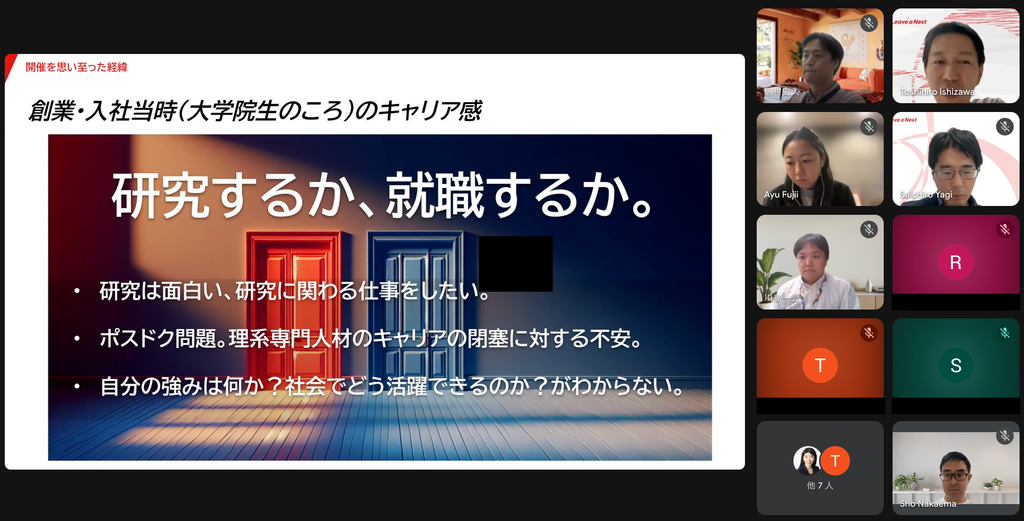
The Role of Researchers Varies Depending on the Stage of Business Growth
Although we often use the term “R&D-focused startup” as a general category, the way research is conducted and the roles expected of researchers vary depending on the company’s business phase.
In the early stages of a startup, it is necessary to explore customer and market needs while verifying the technical feasibility of the technology, and to define the direction of the business. It is not uncommon for researchers themselves to be involved not only in technology development but also in fundraising, engaging with customers, and developing business plans.
As products and services progress toward commercialization, it becomes important to improve performance to meet customer demands, ensure consistent quality, and develop technologies for mass production. Furthermore, as the business expands, R&D organizations and facilities become more established, and roles are increasingly divided by specialty; at the same time, opportunities arise to work on the development of new technologies for the medium to long term.
Of course, actual research environments vary depending on a company’s size and business sector, so the process does not necessarily follow this sequence. All of the speakers featured in this article have been deeply involved in management and business development. Therefore, in this article, we will focus particularly on,How researchers think and act at a stage where technological development and business creation are closely intertwinedWe'll focus on and introduce [...].
The difference from college lies in how we apply our achievements and our awareness of time.
How does the approach to research differ at R&D-focused startups compared to universities?
In response to this question, Mr. Kawashima noted that while research activities themselves remain essentially unchanged, there are differences in how research outcomes are viewed and in people’s perception of time.
In academia, publishing new findings as research papers is considered one of the most important achievements. On the other hand, companies engaged in business operations are also required to protect research results as intellectual property and utilize them in their business activities. Mr. Kawashima explained that, in addition to the increasing number of situations where patents take priority over research papers, there is a significant time-sensitive responsibility—failure to produce results within a set period could even affect the company’s survival.
Mr. Fujii also points out that the shift in focus from basic research to applied research is one of the differences between his university research and his current job. At Morus, data obtained through research is utilized in business operations as evidence demonstrating a product’s functionality and value. In addition to gaining new insights, it is necessary to consider how those findings can be linked to product development and the delivery of value to customers.
On the other hand, while Mr. Iimura says his basic research activities haven’t changed significantly, starting his own company has given him responsibilities as a business owner, leading him to take on tasks beyond research. Even so, he says that being involved in a variety of tasks has broadened his perspective, and he finds his work deeply rewarding.
Even for research-and-development-oriented startups, the fundamental process of research—formulating hypotheses, conducting experiments, and verifying results—remains the same. However, when it comes to how to utilize the results obtained and what to achieve by when, the connection to the business becomes more direct.
Moving forward with social implementation without waiting for the technology to be perfected
During the roundtable discussion, a participant asked how to secure research funding and equipment at a stage when research results sufficient for commercialization had not yet been achieved.
In response, Mr. Iimura expressed the view that research and development is a never-ending process, and that if one waits to start a business until all results are in, one will never get started.
Mr. Fujii also recalls that when he joined Morus, the technology was still in the development phase. He explained that even under those circumstances, the company was able to proceed with development while raising funds by communicating its vision for the future and the potential of the business. For R&D-focused startups, commercialization does not necessarily begin only after the technology is fully developed. Often, they conceive of the products or services they wish to bring to market, develop the necessary technology to achieve that vision, and simultaneously seek out customers and partners while raising funds.
In other words,Rather than waiting until research is complete to implement it in society, we advance our research as part of the process of aiming for societal implementation.That's how we proceed.
For example, new technical challenges may emerge from discussions with customers, or the direction of research may shift as a result of proof-of-concept testing. The very act of advancing a business venture can itself provide opportunities to discover new research topics. Delivering research results to society and further advancing research are not necessarily separate stages. The ability to pursue both simultaneously is one of the defining characteristics of R&D-driven startups.
The joy of making your own decisions within limited constraints
You might imagine that in R&D-focused startups, researchers are able to take the lead in their work. However, that does not necessarily mean they are free to conduct research based solely on their own interests. The direction and priorities of research may be constrained by customer requirements, funding availability, business plans, and other factors. Within limited time and budget constraints, it is necessary to determine which technical challenges to prioritize and to what extent to validate them.
In fact, the fact that one’s decisions affect both research and business operations within these constraints is a characteristic unique to R&D-driven startups.
We also received a question asking how we find time to come up with new ideas while juggling our daily experiments and work.
Mr. Fujii explained that precisely because their daily work is so busy, they make a point of setting aside time to discuss long-term plans.
Mr. Kawashima also noted that engaging in business activities across different fields can bring together knowledge that previously had no connection, leading to the emergence of new ideas. He also touched on the importance of setting aside time not only to tackle immediate tasks but also to think about systems and conduct thought experiments.
Working at a research-and-development startup does not necessarily mean you’ll have more time to focus on research. You’ll be expected to engage in tasks beyond research, think about what’s needed to move the business forward, and take initiative. At the same time, through these activities, you may encounter challenges you wouldn’t have found within the confines of a lab, as well as new possibilities for research.
A New Way to Engage That Leverages Your Expertise
In this roundtable discussion, three participants shared their experiences working at R&D-focused startups, discussing both the excitement and the challenges of advancing research and business simultaneously.
The fact that research outcomes lead directly to business opportunities; the need to determine the direction of research within limited constraints; and the emergence of new challenges through interactions with customers and experts from other fields—these can be considered key characteristics when viewing R&D-driven startups as research environments.
Of course, universities, public research institutions, and the R&D departments of large corporations each have their own unique research environments and appeal. R&D-focused startups are not necessarily the best fit for every researcher.
Furthermore, your involvement with startups isn’t limited to employment or starting your own business. You could also engage in joint research while still enrolled in college or contribute to technological development by leveraging your expertise. How do you want to further develop the research you’re currently working on? To whom, and in what form, do you want to share the results?
When considering your future as a researcher, learning about R&D-focused startups may provide a new opportunity to reflect on your expertise and the potential of your research.
Recruitment and R&D Information for Presenting Companies
The companies featured in this session are actively collaborating with professionals from diverse fields to bring their research findings to practical application in society. We encourage you to review the publicly available information from each company regarding the nature of their R&D work and the roles they seek to fill.
- Hundred Semiconductors, Inc. | Official Website
- Morus, Inc. | Job Openings for Research and Development Positions
- IntegriCulture, Inc. | Careers
*Recruitment status and application requirements are subject to change. Please check each company's website for the latest information.
Why not talk directly with a research-and-development-focused startup?
For those interested in working at a research and development-focused startup, an event titled “Ad Venture Forum Tokyo Fall 2026" will be held.
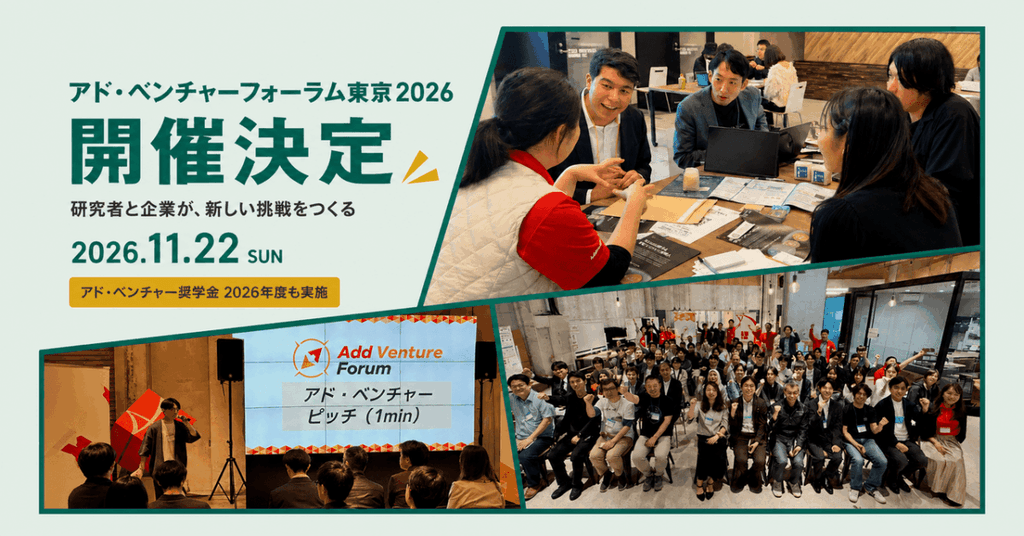
This event provides a forum for graduate students, postdocs, and early-career researchers to meet with research-and-development-oriented startups, share their expertise and interests, and explore new research topics and opportunities for collaboration.
Unlike typical company information sessions, this event allows you to engage in direct dialogue with executives and employees from participating companies while considering how you can apply your research and expertise. During the booth sessions, you’ll discuss the technical issues companies are addressing and their future challenges, and generate ideas for joint research and pilot projects.
We will also hold the “Ad-Venture Pitch,” an event where participants present ideas that emerged from dialogues with companies. Selected participants will receive an Ad-Venture Scholarship of up to 100,000 yen to cover the costs of bringing their ideas to life.
Outline
- Event Name: Ad Venture Forum Tokyo Fall 2026
- Date and Time: Sunday, November 22, 2026, 1:00 p.m. – 5:30 p.m.
- Venue: Center of Garage (1-16-3 Yokogawa, Sumida Ward, Tokyo)
- For: Graduate students, postdocs, and early-career researchers
- Organized by: Leave a Nest
You don’t have to have already decided to join a startup. If you’re interested in further developing your research or exploring ways to apply your expertise in the real world, we encourage you to participate.
Click here for event details and to register
*You must register for a Ribane ID to apply to participate.
 English
 Japanese