

- News
- Kyoto Deep Tech.
Discover university-developed technologies and expand your horizons
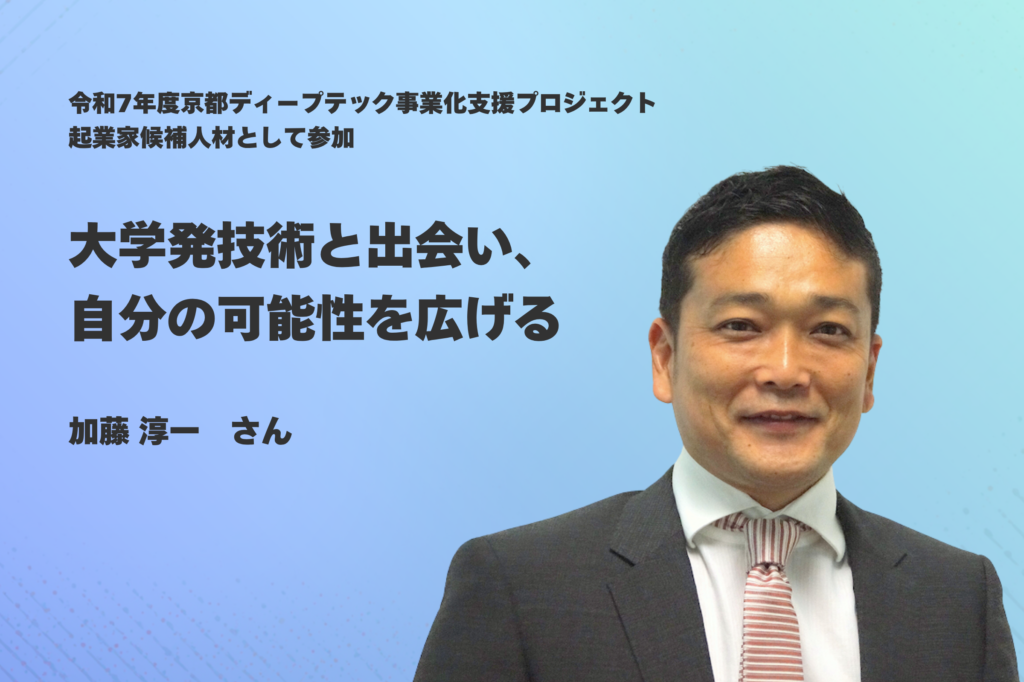
"I want to put university research and technology to better use for society." Driven by that desire,Kyoto Deep Tech Commercialization Support ProjectJunichi Kato participated in the program. While he had experience in the software industry, he ventured into the field of materials research—an area outside his expertise—and teamed up with researchers to take on the challenge of commercializing their work. Through a series of lectures, market research, and discussions with researchers, he came to realize not only the potential of a new business but also the role he himself, as an entrepreneur, should play in society.
The Potential I Saw in “Launching a Deep Tech Startup”
Mr. Kato joined this project because he had long been interested in deep-tech ventures. Although he had been involved in launching multiple businesses in the software sector, he began to feel that “this is the kind of work that doesn’t necessarily have to be done by me.” On the other hand, when he considered what Japan’s true strengths were in competing on the global stage, he came to believe that the answer might lie in the research and technology accumulated at universities. He subsequently participated in a program to learn how to support the commercialization of deep tech, where he gained experience in mentoring researchers and developing business strategies. However, he had almost no opportunities to actually engage with university-developed technologies or work in teams with researchers to develop business ideas.
The Kyoto Deep Tech Commercialization Support Project is more than just a series of research presentations. Through repeated direct dialogue with multiple researchers, participants identify researchers whose work aligns with their own experiences and concerns, form teams, and work together to advance commercialization. For Mr. Kato, this was a golden opportunity to dive into an unfamiliar field of research and expand his own potential.
We choose researchers not just for their technical skills, but because we want to take on challenges with them
In this project, aspiring entrepreneurs do not simply choose researchers based on their research topics alone. From the very first session, they engage in direct dialogue with multiple researchers, learning about each researcher’s work, personality, and approach to real-world implementation, while considering “who they want to build a business with.”
The person with whom Mr. Kato decided to collaborate was Professor Shinnosuke Nishimura of Doshisha University. Professor Nishimura’s research focuses on polymer materials, aiming to develop a wide range of applications by utilizing new materials derived from biomass. Materials research was uncharted territory for Mr. Kato. Even so, he said that from the moment they first spoke, he had a feeling that “I could work with this professor.” In addition to the research content itself, their shared enthusiasm for commercialization, ease of communication, and compatibility in their ways of thinking were also key factors in his decision. A defining feature of this program is that researchers and aspiring entrepreneurs select one another and build teams together.
After selecting the researchers to collaborate with, a series of lectures and hands-on sessions aimed at commercialization began and lasted for about half a year. The lectures were not intended to provide “how-to” guidance or skill-building; rather, they were designed to establish a shared foundation—the mindset and attitude necessary for commercialization in the deep tech field, where development requires a long-term commitment. We began by articulating our own passions, then learned how to perceive social issues, explore potential applications for technology, and approach trial and error while formulating business “hypotheses.” Through this process, we defined the “challenges” we wanted to solve and envisioned the world we hoped to create. Building on that foundation, we then conceived “solutions to these challenges” by combining our ideas with the instructors’ knowledge and technical expertise.
Refine business ideas through repeated hypothesis testing
What left the strongest impression on Mr. Kato was the phrase, “Gather your tools as you go.” Rather than waiting until you’re fully prepared to take on a challenge, you should gather knowledge as you move forward, meet people, and continually refine your hypotheses. This mindset is considered crucial for commercializing deep tech. To understand research on polymer materials—a field outside his area of expertise—Mr. Kato pored over research materials, organized the information using AI, and repeatedly sought feedback from professors and mentors.
Furthermore, the program required participants not only to understand the technology but also to research real-world market and industry challenges, link the technology to societal issues, and formulate business hypotheses based on that connection. Drawing on his experience working with local governments, Mr. Kato identified regional challenges and personally visited government officials, academic societies, and major corporations to gather firsthand feedback. Beyond the initial intended applications, a new challenge—resource recycling associated with the widespread adoption of perovskite solar cells—also came to light. Mr. Kato realized that a business cannot be built on laboratory technology alone or market challenges alone; what is required of aspiring entrepreneurs is precisely the ability to bridge the two. He agonized over his two business proposals until the very end and ultimately decided to pursue the theme of recovering and recycling rare resources.
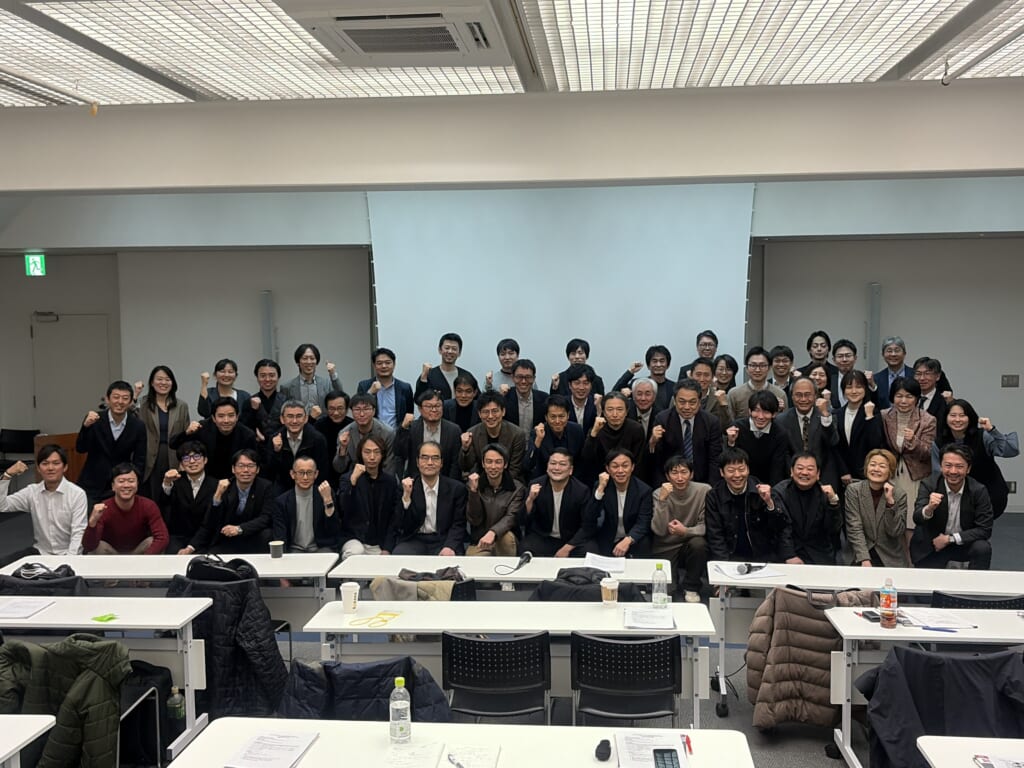
Group photo from the business presentation session for the Reiwa 7 Kyoto Deep Tech Commercialization Support Project
I'm glad I participated. You have nothing to lose by giving it a try.
The project doesn’t end with the presentation of a business plan. Mr. Kato and Professor Nishimura are currently working together to apply for research grants, while also holding ongoing discussions regarding the timing of the company’s establishment, the division of roles, and the involvement of lab members. Researchers’ primary roles are in education and research, and they work on commercialization within their limited time. Mr. Kato says that building a team that leverages each member’s strengths while respecting this reality is the first step toward societal implementation.
This kind of co-creation has also led to new challenges, such as applying to external acceleration programs and engaging in dialogue with venture capitalists. “If I could speak to my past self before joining the program, I’d tell him, ‘I’m glad I participated,’” Mr. Kato reflects. Regardless of whether you decide to start a deep-tech startup, this program allows you to meet researchers and consider how your own experiences and strengths can be applied to solving societal challenges. You’ll team up with researchers, learn through lectures, visit the market, and refine your hypotheses time and again. Through this cumulative process, your own potential and the role you wish to play in society gradually come into focus. The Kyoto Deep Tech Commercialization Support Project serves as a practical platform for those who want to take on new challenges, helping them take that first step.
<プロフィール>
Mr. Junichi Kato
As a serial entrepreneur, he has been involved in founding five companies both in Japan and abroad, raising a total of 450 million yen in funding. At a Web3 company he founded in Southeast Asia, he led a multinational team of approximately 100 people. While addressing local challenges as an entrepreneur dedicated to regional revitalization in Shirako Town, Chiba Prefecture, he is also taking on the challenge of commercializing technology seeds originating from Doshisha University through this project. He has been selected for the NEDO NEP program and the 14th cohort of the SME Support Agency’s FASTAR program. He aims to realize a circular society through the integration of “local resources and deep tech.”
 English
 Japanese