

- Interview with Adventure Talent
- News
Expressing new values and bringing people together amid a diversity of perspectives
This article is a re-edited version for online publication, based on an interview originally featured in Vol. 25 of the “Human Resources Support” booklet, titled “The Turning Point of 2025,” which was published in September 2024.
Speaker
Ms. Ruri Maekawa
Second-year master's student, Graduate School of Interdisciplinary Cultural Studies, The University of Tokyo
Born in 1999 in Kyoto Prefecture. While enrolled in the Faculty of Engineering at Osaka Prefecture University in 2022, he began his activities as a member of the 6th cohort of MAKERS UNIVERSITY and founded the research community “Mitsubachi.” He established QueenB, Inc. to manage the community and has organized numerous events to help young researchers secure research funding. In 2023, he was selected as a member of the first cohort of the Lifeness Scholarship program and hosted his first overseas event, “Asia Science Hive,” in Malaysia in October 2023. While continuing these activities, she is currently conducting research on artificial organoids in graduate school and, through her company, is collaborating with Tohoku University to create a community of PhDs with an entrepreneurial spirit and to develop robots that automate research.
Interviewer
Yuko Ueno
Lifeness Co., Ltd., General Manager, Group Development Division, Human Resources Development Department
Director, Leave a Nest Malaysia Sdn. Bhd.
Ph.D. (Science). During his time as a student, he studied extreme environment biology while studying abroad in the United States, exploring the origins of life. He joined Leave a Nest Co., Ltd. in 2013. After serving in various roles, including General Manager of the Human Resources Development Division, he became General Manager of the Group Development Division in October 2021 and has served as a Director of Leave a Nest Malaysia Sdn. Bhd. since November of the same year. He identifies and nurtures deep-tech startups in the United States, the United Kingdom, Singapore, Malaysia, and the Philippines—where the Leave a Nest Group has a presence—while also designing new business ventures for Japanese companies in collaboration with these startups.
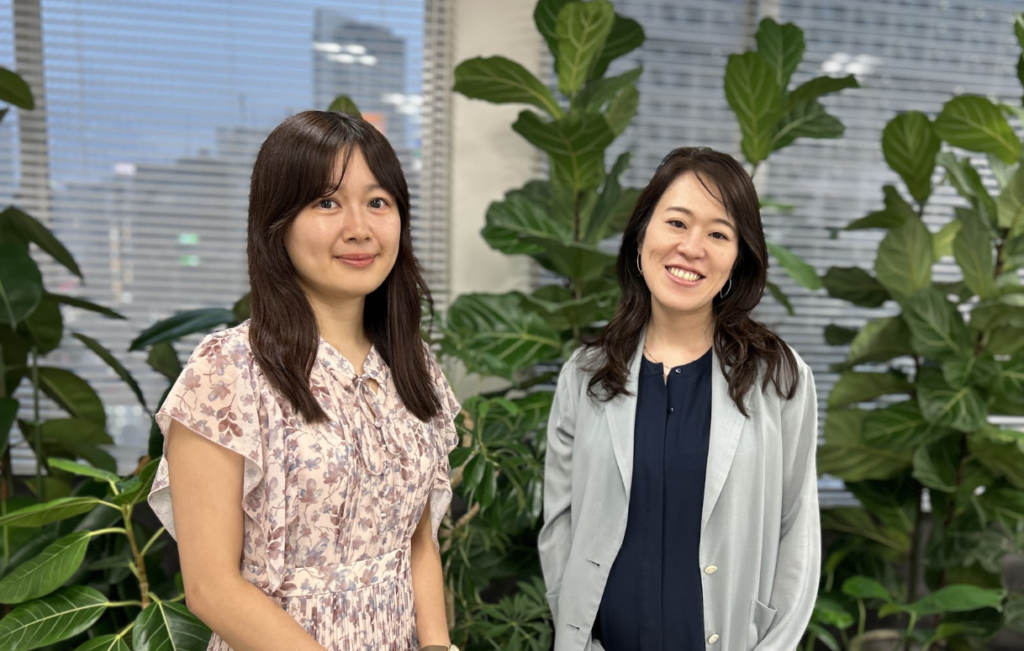
Ruri Maekawa is currently pursuing graduate studies at the University of Tokyo. As a founding member of QueenB, Inc., she is working to create a society where anyone who wants to conduct research can do so, through initiatives such as managing the research community “Mitsubachi.” Selected as a member of the first cohort of the Lifeness Scholarship, she organized and successfully hosted “Asia Science Hive,” an event in Malaysia designed to help young researchers secure research funding, inspired by a seminar activity supporting scholarship recipients. What values drive her—a young researcher still in the midst of her own professional growth—to engage in such initiatives? We speak with Yuko Ueno of Lifeness Co., Ltd.—who also serves as a director of Lifeness Malaysia and supported Ruri’s efforts through the seminar activities—to find out.
Not just information, but...
See for yourself
Ueno: I heard that you’ve loved research since your freshman year of high school. What made you want to do “research” in the first place? There are science classes in middle and high school, but what you do there is “experiments,” right? Experiments are a way to experience firsthand what you learn in textbooks—they’re like a recipe book that gives you the answers for making a delicious meal. But research, where you tackle problems with no set answers, is different. Where did you discover the joy of research?
Maekawa: Back in high school, I was a total chemistry nerd—all I ever thought about was research. I first got into research when I participated in an initiative called the Global Science Campus. It was a program that allowed high school students to conduct research at universities. I went to places like Osaka University and Kyoto University, where I synthesized new fluorescent molecules and investigated how their fluorescence intensity varied depending on their structure. Even the professors didn’t know the results. It was really fun to unravel the mysteries of unknown substances that weren’t even in textbooks.
Ueno: I see. But why did you decide to participate in that kind of initiative in the first place?
Maekawa: Actually, at first it was about choosing a career path. Up through high school, science subjects were categorized as “math” or “physics.” But when I filled out the university application survey, terms like “Natural Sciences” and “Engineering” suddenly appeared, and I realized they were viewed within a completely different framework. I didn’t understand how they differed from one another. Around that time, a friend suggested, “Let’s go check out the differences between engineering and natural sciences together.” I thought that would be a valuable experience to help me make my decision, so I joined the program.
Ueno: When I think back to my high school days, I don’t recall ever thinking, “I should go check out what’s written in the college brochures”; I think I just made my decisions based on the information provided. I imagine it’s much easier to access a wealth of information now than it was back then, but do you still feel the urge to “see it with your own eyes”?
Maekawa: That’s true. As the saying goes, “Seeing is believing,” but I think I trust my own experiences the most. After all, the internet can’t tell you whether you’ll find something interesting or if it’s a good fit for you, can it? Of course, I think being in a privileged environment where I could actually try things out played a big part, too.
Times when things don't go as planned
Broaden Your Horizons
Maekawa: After that, I entered college because I wanted to do research, but that’s when I first realized that, apparently, first-year undergraduates aren’t allowed to do research. I wanted to do chemistry research, but I was told, “It’s too dangerous to let freshmen do that,” and “You need to learn the basics in class first.” At first, I thought that system could surely be changed, so I went straight to the department chair to plead my case, but the answer was the same.
Eventually, I stopped liking chemistry much either. I really enjoyed the balance between active learning—where I could independently investigate what I wanted to know through research—and incidental learning, like what happens in a classroom. Back in high school, those two aspects were interconnected, but by my freshman year of college, it had become one-sided. Actually, I had failed to get into my first-choice university, so I was feeling very sad at the time. But when I thought about why I felt that way, I realized that because I’d done nothing but research since high school, I could only measure my worth based on the standards of research and academia. I thought that—even if it was just me—it wouldn’t be a rich life to judge the people I’d meet in the future, as well as the world and the times, based on a single set of values. So, I decided to deliberately try doing things outside of research. I tried attracting 100 people to an event, got involved in startup-related initiatives, and participated in all sorts of activities like that.
Ueno: I see. It’s also important to go through a phase where you consciously try to broaden your horizons, isn’t it?
Maekawa: Through organizing events, I talked with many people—including those in fields I hadn’t been interested in—but in the end, I realized that research was what truly drew me in. Even after learning so many different things, I realized that if I truly loved research, I should give this path another shot. So, I decided I couldn’t pursue research in Japan, applied for an overseas study program, and was accepted for a short-term study abroad program at the Georgia Institute of Technology. However, just as I was about to leave, the global spread of COVID-19 began, and my study abroad plans for that year were postponed.
Ueno: Around winter 2021 was a really tough time, wasn't it?
Maekawa: Thinking, “If I can’t do anything anyway,” and drawing on my own experience of being unable to conduct research when I entered college, I began creating a system that would allow even undergraduate students to conduct research. While working on this, I learned about MAKERS UNIVERSITY, run by ETIC., an NPO that supports student entrepreneurship. At first, I hesitated because I had no experience with entrepreneurship, but when I considered what I had to lose by applying—and realized I had nothing to lose—I decided to take the plunge, seeing the application process as a valuable opportunity to reflect on what I truly wanted to do. The program began in the winter of my sophomore year. There, we were told, “Starting today, you are entrepreneurs,” and we were drilled in a new way of thinking that emphasized the importance of listening to others and solving problems above all else.
Ueno: So, the work you did here led to the launch of the research community “Mitsubachi,” which you currently run, and to the founding of your company, didn’t it?
From a Dichotomy of Different Values to Integration
Maekawa: On the other hand, since I still had the right to attend Georgia Institute of Technology, I went to the U.S. during the summer of my junior year. At the time, I would do research at the university during the day, and then, after returning home, take MAKERS courses online until dawn.
Ueno: Isn't that really tough? How were you able to keep that up? You could have chosen to quit one of them, right?
Maekawa: I had decided to use that time to figure out whether I was an entrepreneur or a researcher—and which path to choose. Back then, I was a very narrow-minded person, and I think I was looking at the different ways of life available in today’s world and trying to force myself into one of those two categories.
Ueno: Does the definition of an entrepreneur at that time mean starting a company?
Maekawa: That’s right. Back then, my definition of an entrepreneur was, if anything, someone who starts a company and builds the system itself so that anyone can conduct research—someone who builds the infrastructure to support the researchers rather than being a researcher themselves.
To be honest, right before I left for the U.S., I hadn’t been doing research for so long that I’d started to wonder if I even liked it anymore. But then I attended a lecture by a Harvard professor while I was there, and it was so fascinating—it really moved me. He was a researcher in crystallography, and I got the impression that he wasn’t doing it because it was useful to others or because it had value, but simply because he loved research. Back then, I thought that “working” meant, for example, starting a business, solving a problem, and receiving money in return. But I realized that there was a part of me that was moved by the simple act of pursuing something just because it was interesting. It was during the summer of my junior year of college that I decided I wanted to continue my research a little longer.
Ueno: I was studying extremophile microorganisms as part of my research into the origins of life, and I greatly admired researchers who could devote all their energy to pursuing their curiosity to the very limit.
Maekawa: Since then, I’ve undergone a bit of a change myself. Up until then, I was someone who didn’t see a connection between my research and the real-world problems I wanted to solve, but I began to take an interest in what kinds of problems the research topics I was working on actually addressed. Now, the research that excites me is the kind that is fascinating as a scientific phenomenon, solves real-world problems, and benefits society.
Ueno: It’s precisely because you did both at the same time that your values have come together, hasn’t it?
People who can express new value
Ueno: Did you make any interesting discoveries while working on the Asia Science Hive project as part of the Lifeness Scholarship program?
Maekawa: I think it was a really great experience to be able to use English while working with a group of people from diverse backgrounds and different nationalities to find a consensus—a common goal that everyone could agree on. Until now, in English-language meetings, I had always been just one participant voicing my opinion, and I had never been in a position where I had to lead the group to a consensus, so this was a new experience for me.
Ueno: Since I also work on projects with members of our overseas subsidiaries, I completely understand how you feel. I feel that the more diverse the group becomes, the more important it is to frequently express respect for others’ perspectives while engaging in discussions.
Maekawa: The more we try to embrace diversity, the more we need to communicate in a way that conveys, “I think your perspective is valuable, and I understand that.” I once read in a book that the reason humans were able to evolve was because we could exchange expertise for value, and I, too, believe that major revolutions and evolution arise from the exchange of expertise and value. If people with the same values gather together, discussions can move along more quickly, but I wonder if the more diverse the group becomes, the slower the decision-making process gets. I’d like to figure out in which phases that diversity is important and in which phases decision-making by a small group is better.
Ueno: On the other hand, when people from different cultural and background backgrounds work together in the same organization, the ability to keep moving toward a common goal even after having a few disagreements is only possible if everyone shares the basic understanding that what we’re trying to do right now is worthwhile.
Maekawa: After all, you can’t make an exchange unless both parties recognize the value. The most challenging part of my scholarship seminar activities was figuring out how to get the other party to envision the future value of something that currently has no value—and to get them to invest in it.
Ueno: In the past, the yardsticks for measuring value—like money or standardized test scores—were straightforward, but I think there are many more of them now. I feel that the ability to articulate why something that doesn’t yet exist has value is far more important. Precisely because we live in such an unstable and uncertain era, I believe this is a generation whose ability to express value is being put to the test.
Maekawa: It’s important to show what value something that doesn’t exist yet has, and to spread the word about it to bring people on board.
Ueno: What kind of activities do you plan to do going forward?
Maekawa: Since becoming a graduate student, I’ve started paying more attention to doctoral students who are in a similar situation to me. Currently, recipients of JSPS (Japan Society for the Promotion of Science) Research Fellowships are recognized as promising young researchers, but once selected, the program’s restrictions make it difficult for them to start a business. This is despite the fact that there are many motivated young researchers conducting work that would have a significant impact on society if it were put into practical use. I want to create a system that eliminates situations where people are prevented from pursuing their goals simply because of qualifications or conditions.
Ueno: That sounds like it will be another way to share new value. I'll continue to support you!
(Written by Miyuki Shigenaga)
 English
 Japanese