

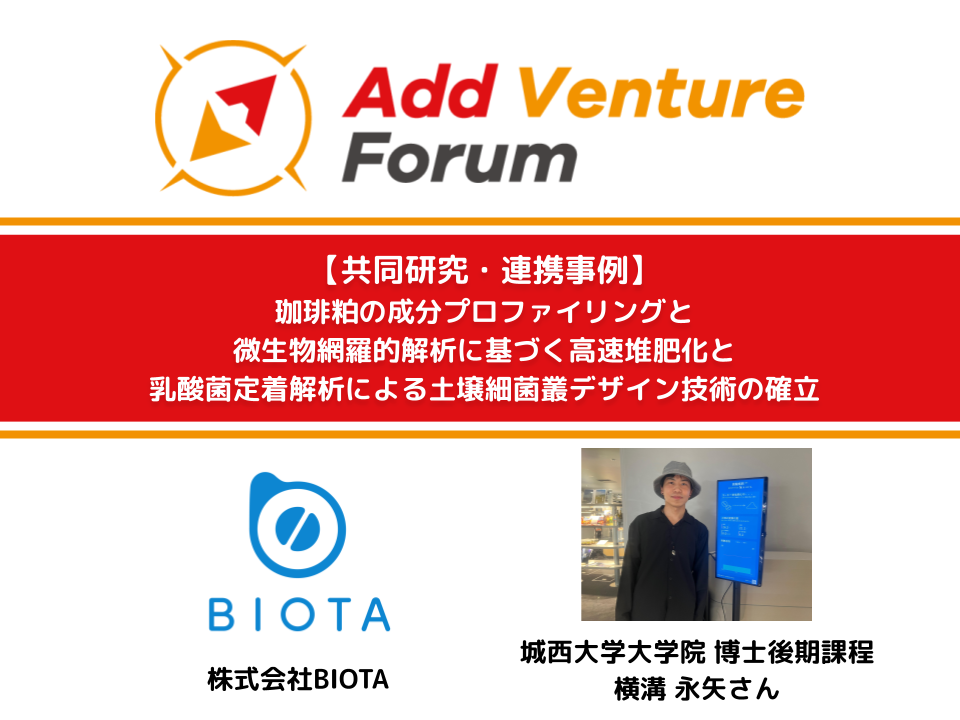
[Examples of Joint Research and Collaboration] BIOTA Launches a Joint Project with Eiya Yokomizo of Josai University Graduate School!
We have now selected the winning projects for the Ad-Venture Scholarship from among the applications submitted at the Ad-Venture Forum held in December 2025.
For information on the Ad Venture Scholarship, please contactthis way (direction close to the speaker or towards the speaker)
Project Title: Establishment of a Technology for Designing Soil Microbiomes Through Analysis of Lactobacillus Colonization, Based on Rapid Composting of Coffee Grounds Using Component Profiling and Comprehensive Microbial Analysis
Company: BIOTA Co., Ltd.
Researcher: Nagaya Yokomizo, Doctoral Student, Josai University Graduate School
Below are the scholarship applications from students.
Details of Cooperation
In this study, we focus on the porous structure and prebiotic effects of coffee grounds to investigate their potential as high-performance biomaterials. Using HPLC-based component analysis as an indicator, we will analyze the relationship between component characteristics and microbial behavior to verify the possibility of shortening the composting process—which typically takes four weeks or more—to a shorter timeframe. Furthermore, by utilizing BIOTA’s microbial analysis technology to comprehensively analyze the microbial communities involved in composting, we aim to establish a resource recycling model that promotes the dominance of beneficial bacteria in the soil microbiome.
Reason for Application
Because the composition of coffee grounds varies significantly depending on roasting and brewing conditions, issues such as germination inhibition and antimicrobial activity have been pointed out in the past. On the other hand, by appropriately controlling these characteristics, coffee grounds have the potential to be utilized as a substrate that selectively activates specific microorganisms. In this study, in collaboration with BIOTA, we will analyze the microbial ecosystem formed within coffee grounds and explore the potential for science-based control of the composting process.
Vision for the future
・Identification of microorganisms adhering to coffee grounds
We analyze the microbial communities present within the porous interior to evaluate the characteristics of microorganisms that promote composting and those that act as inhibitory factors.・Verification of the Feasibility of Short-Term Composting
We will evaluate the progress of composting using indicators such as residual polyphenol content and the C/N ratio, and examine the feasibility of an efficient treatment process.・Development of a Resource Recycling Model
We will organize the conceptual framework for evaluating the quality of coffee grounds based on their chemical and microbiological characteristics, with the goal of developing a model that leads to sustainable resource use.




 English
  Japanese